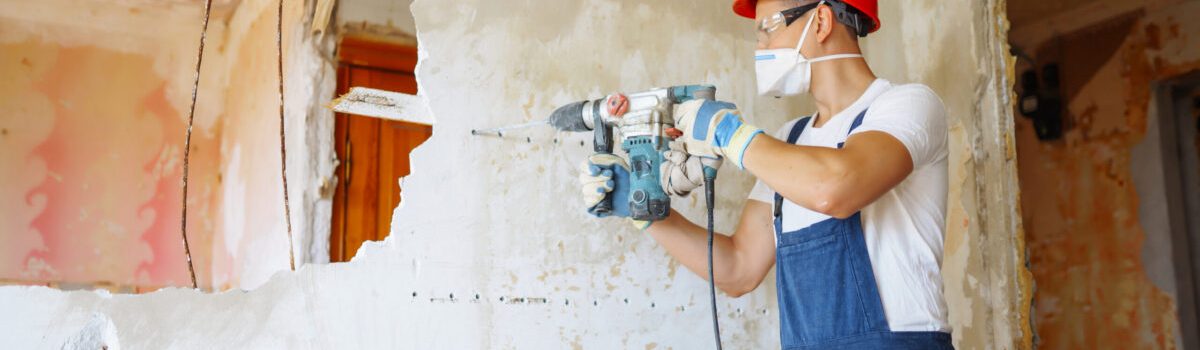
If your home or business has water damage, mold damage, or fire damage, demolition of building materials may be required during restoration. This raises an important question many property owners ask:
Is asbestos testing necessary if insurance says it isn’t covered?
Key Takeaway
Before disturbing building materials that could contain asbestos, OSHA requires the hazard to be identified. If documentation proving materials are asbestos-free is not available, the materials must either be treated as asbestos or verified through testing before demolition.
OSHA Requirements for Asbestos Identification
The Occupational Safety and Health Administration (OSHA) regulates worker exposure to asbestos under 29 CFR 1926.1101.
OSHA’s standard focuses on protecting workers from airborne asbestos fibers. The regulation does not say testing must occur in every situation, but it does require that asbestos hazards be identified before materials are disturbed.
OSHA states:
“Building and facility owners shall determine the presence, location, and quantity of ACM and PACM at the work site and shall provide this information to the following persons or employers.”
— OSHA 29 CFR 1926.1101(k)(2)(i)
OSHA also requires contractors performing work to obtain that information:
“Employers performing work subject to this standard shall obtain the information required in paragraph (k)(2)(i) of this section from the building owner or employer and shall inform their employees of the presence, location, and quantity of ACM and PACM.”
— OSHA 29 CFR 1926.1101(k)(2)(iii)
What this means in simple terms
Before disturbing building materials:
- Someone must determine whether asbestos-containing material (ACM) or presumed asbestos-containing material (PACM) is present.
If documentation proving materials are asbestos-free does not exist, the materials must either:
- Be treated as asbestos, or
- Be verified through asbestos testing
The 1980 Rule (Often Misunderstood)
Many insurance representatives and property owners believe asbestos only needs to be considered in buildings built before a certain year.
OSHA does reference building age, but not in the way many people assume.
OSHA defines Presumed Asbestos-Containing Material (PACM) as:
- Thermal system insulation
- Surfacing materials (sprayed fireproofing, acoustic texture, etc.)
- Resilient flooring materials
installed no later than 1980.
These materials must be treated as asbestos unless testing proves otherwise.
However, OSHA does not say buildings constructed after 1980 are automatically asbestos-free. It simply defines when materials must be presumed asbestos.
Common Building Materials That May Contain Asbestos
The Institute of Inspection Cleaning and Restoration Certification / American National Standards Institute S500 Standard requires restorers to identify hazardous materials and comply with OSHA before disturbing them.
Common materials that may contain asbestos include:
- Mineral fiber ceiling panels
- Gypsum drywall joint compounds
- Resilient flooring (vinyl composition tile, vinyl sheet flooring, linoleum)
- Flooring adhesives
- Pipe insulation
- Wall and ceiling insulation
- Concrete masonry unit (CMU) block cores loose-filled with vermiculite, perlite, or similar materials
These materials are frequently encountered during water damage restoration, mold remediation, and fire damage repair projects.
Why Restoration Projects Often Require Asbestos Testing
Water damage mitigation and other restoration work frequently require:
- removing drywall
- pulling flooring
- opening walls
- removing insulation
- demolition of building materials
When materials are disturbed, dust and fibers can become airborne. If asbestos is present, this creates a potential health risk.
Because of this, OSHA requires asbestos hazards to be identified and communicated before work begins.
OSHA also states:
“Building and facility owners shall provide the following information to employers of employees who will perform work within or adjacent to areas containing such material…”
— OSHA 29 CFR 1926.1101(k)(2)(ii)
In real-world restoration projects, most property owners do not have documentation confirming that materials are asbestos-free. When documentation is unavailable, the contractor must either:
- assume asbestos is present, or
- verify through asbestos testing.
What About Newer Homes?
Many people assume newer homes cannot contain asbestos.
While asbestos use has been heavily restricted in the United States, it has not been completely banned for all products. Some building materials can still be manufactured or imported from countries where asbestos is used.
Because of this, asbestos has occasionally been identified in newer construction materials.
From personal experience in the restoration industry, I have seen positive asbestos test results in structures built as recently as 2023. In those cases, asbestos was identified in drywall systems and joint compound materials.
This does not happen on every project, but it demonstrates why building age alone should not be used to assume asbestos is not present.
Will Insurance Cover Asbestos Testing?
Whether insurance covers asbestos testing depends on the policy.
In our experience:
- Some insurance companies cover testing without question
• Some request justification and then approve it
• Others deny coverage if they believe the building is too new
We have even seen the same insurance company approve testing on one claim and deny it on another.
Why TriForce Restoration Evaluates Materials for Asbestos
As a restoration company, we have a responsibility to protect:
- our employees
- property owners
- building occupants
OSHA requires employers to protect workers from asbestos exposure and identify asbestos hazards before disturbing building materials.
Because restoration work often involves opening walls, removing flooring, and demolition, potential asbestos-containing materials must be evaluated so work can be performed safely and in compliance with OSHA regulations.
For this reason, TriForce Restoration evaluates materials for potential asbestos content before performing demolition of materials that could contain asbestos.
Frequently Asked Questions
Do contractors have to test for asbestos before demolition?
Not always. OSHA requires that asbestos hazards be identified before materials are disturbed. If documentation proving materials are asbestos-free is not available, contractors must either assume asbestos is present or verify through testing.
Does insurance always cover asbestos testing?
No. Coverage depends on the insurance policy and the specific claim adjsuter.
Can newer homes contain asbestos?
Yes, in some cases. Asbestos has been identified in newer construction materials, including drywall systems and joint compounds.